InstaBasic
₹ 15
per companySearch the complete National Industrial Classification system — NIC 2025, 2008 and 2004 — for Udyam, MSME, GST, LLP and company registration.
Everything you need to know before you pick a code — what it means, who issues it, and why getting it right actually matters.
NIC stands for National Industrial Classification — a standardised coding system that categorises every kind of economic activity in India into sections, divisions, groups, classes and sub-classes. It allows uniform collection of data.
It provides a uniform way to record, compare and analyse business activity across India.
Issued by the Ministry of Statistics and Programme Implementation (MoSPI).
An incorrect code can delay registration approvals, misrepresent your business, affect eligibility for benefits, and create mismatches during GST or bank audits. Picking the precise class protects your compliance.
A valid NIC code is a mandatory field across almost every business registration and compliance process in India. Here's where you'll need one.
NIC code identifies your manufacturing or service activity — mandatory for Udyam/MSME online registration under MoMSME guidelines.
The Udyam portal requires a 5-digit NIC 2008 or NIC 2025 sub-class to categorise your enterprise's primary economic activity.
MCA's SPICe+ form (INC-32) requires a valid NIC code to specify the nature of business for Private Limited Company incorporation.
Limited Liability Partnership registration via the FiLLiP form on the MCA portal mandates selection of the appropriate NIC sub-class.
GST registration forms require a NIC code to describe the principal supply of goods or services for tax classification purposes.
Factory licensing under the Factories Act requires a NIC code to classify the industrial process and map it to applicable safety regulations.
IEC applications filed with DGFT must include a NIC code that accurately represents the nature of your import or export trade activity.
DPIIT Startup India recognition requires a NIC code to confirm the startup operates in an eligible innovative sector per the scheme criteria.
GeM and other public procurement portals use NIC codes to match vendors to tender categories — the right code improves your tender discoverability.
Explore the full Section → Division → Group → Class → Sub-Class hierarchy for each classification year.
Get the original MoSPI publications for every classification year, from the current edition back to 1970.
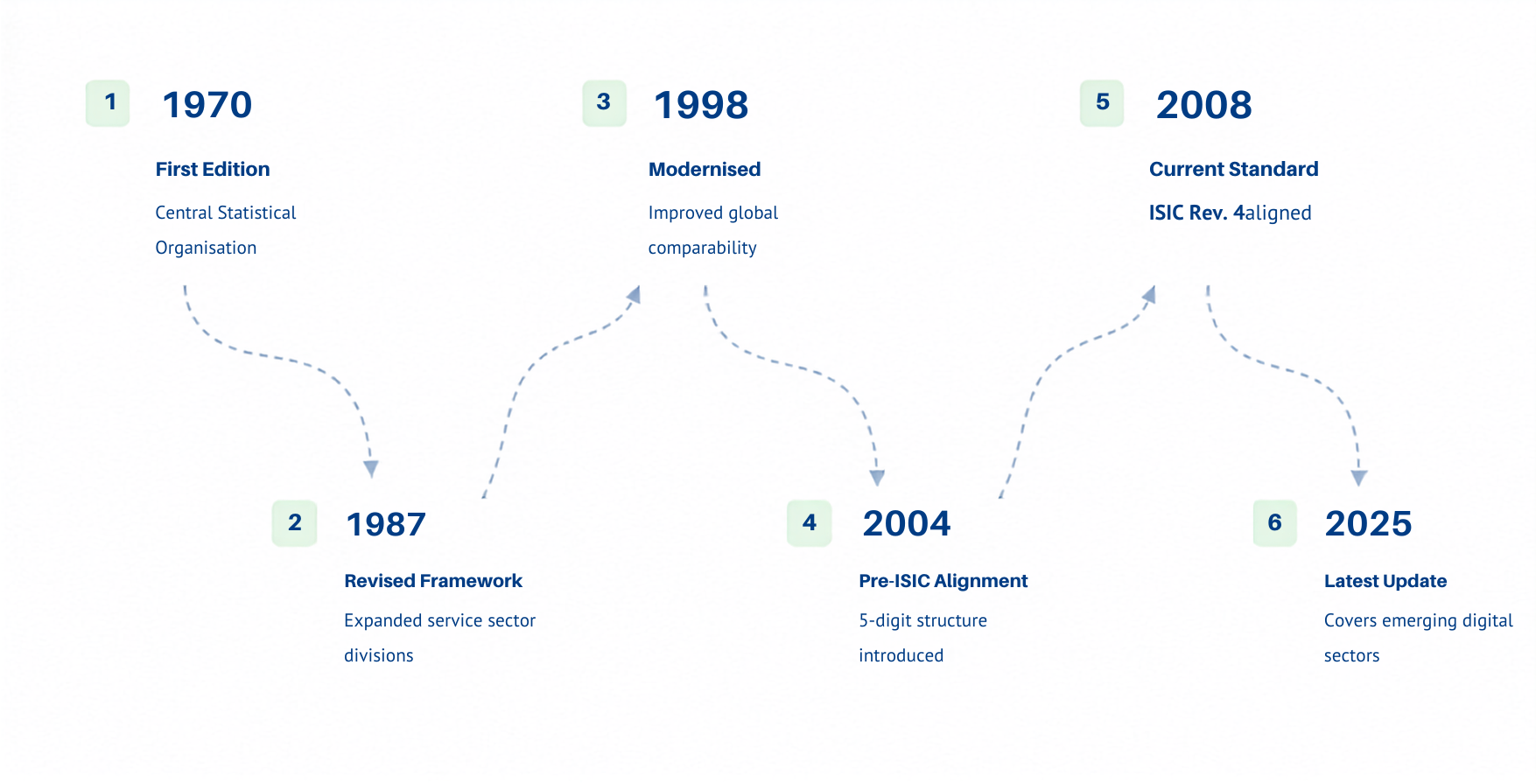
From its first edition in 1970 to the latest 2025 update, the NIC classification system has evolved alongside India's economy.
Udyam registration currently accepts NIC 2008 and NIC 2025 codes. NIC 2004 is used only for historical or legacy records.
Yes. NIC Code Finder is completely free — no sign-up or payment required to search, browse or download any classification year.
Yes, official PDF publications for NIC 2025 down to NIC 1970 are available to view and download from the Download NIC section above.
NIC stands for National Industrial Classification — a coding system used by the Indian government to classify businesses by their economic activity.
NIC codes typically go up to 5 digits, representing Section, Division, Group, Class and Sub-Class in a hierarchical structure.
GST registration generally accepts NIC 2008 codes, though newer filings are gradually moving toward NIC 2025. Check your specific portal for guidance.
Yes. The Ministry of Corporate Affairs (MCA) SPICe+ form requires a valid NIC code to identify your company's main business activity.
NIC 2025 is the latest revision, adding coverage for newer digital economy and service sectors not present in NIC 2008.
No account is required. Just search or browse — all classification data is publicly accessible without sign-up.
An imprecise NIC code can delay approvals, misstate your business activity to regulators, and create mismatches during GST, MSME, or bank audits — always pick the most specific matching class.